Before
Choose deliberately
Approve the meeting, set its objective and review exactly what MIRA may say, ask and never commit to.
Mirror Intelligent Response Architect
MIRA is a disclosed AI delegate for the exploratory meetings you cannot attend. It learns how you ask, listen and evaluate; joins under its own identity; explores without making commitments; and returns every decision to you.
Disclosure is non-configurable and verified per meeting. There is no stealth mode to switch on, at any price.
No price confirmed, no term agreed, no offer extended. Every commitment routes back to you through the Handback Ledger.
The Owner Cognitive Profile is built from your speech and your writing. Everyone else in the room is context, never voice.
Delegate presence, keep authority
Notetakers save writing time after a meeting. MIRA is designed to return the meeting itself—starting with low-risk, exploratory conversations where the work is listening, asking and qualifying rather than deciding.
Before
Approve the meeting, set its objective and review exactly what MIRA may say, ask and never commit to.
In the room
MIRA joins as a named AI participant, follows your questioning style and routes decisions back to you.
After
Read an evidence-linked digest, answer the open handbacks and turn the useful conversations into next steps.
In the room
Voice-to-voice budget · P50
Illustrative budget · not production measurements
Try to make it commit
Handbacks logged this meeting: 0. Every refusal becomes a one-tap decision in the owner's ledger — nothing is dropped, nothing is decided.
Why now
The pain is measured, not anecdotal. The capability just cleared the conversational threshold. And transparency stopped being a virtue and became a legal obligation — sixteen days after this was written.
interruptions a day — one every two minutes — on top of 153 Teams messages and 117 emails. Half of all meetings land in the two peak-focus windows. The scarce asset stopped being information. It's synchronous presence.
voice-to-voice, in production. Human turn-taking gaps average 200ms; past 500ms a pause registers as awkward. Production stacks now sit inside the natural band — and $1.8B+ of equity followed them in.
2026: disclosure becomes law. Anyone deploying an AI that talks to people must say so, with machine-readable marking of synthetic audio from December. Penalties reach €15M or 3% of global turnover.
Article 50 enforcement day. Every competitor built a bot that hides. We built the disclosure into the conversation — which means our compliance work shipped as our positioning. How we handle it →
The position
"Notetakers listen. Avatars lip-sync. Screening bots interrogate. MIRA converses as you, tells people it's doing so, and hands you back the decision."MIRA positioning · ALz47
Everyone else treats disclosure as a liability to minimise. We made it the product.
The load-bearing rule
One invariant carries the whole product. It is enforced by a deterministic Commitment Firewall that sits outside the language model and vets every outbound sentence before audio exists. Not a prompt. Not a setting anyone can loosen.
versioned commitment-pressure cases pass deterministically. This is local policy evidence, not live meeting or model-quality evidence.
No live service or production incident rate is claimed. Zero commitment leakage remains the release target.
Release target; the current corpus is incomplete. When evidence is absent, the tested foundation abstains and creates a handback.
How it works
Connect Gmail, Slack, and your Zoom or Meet recordings; a 25-minute cold-start interview seeds the profile before any history accrues. MIRA models your speech — vocabulary, signature questions, evaluation parameters, tone registers per audience, and your boundaries. Other participants are conversational context and are never absorbed into your voice.
Every fact carries a source, a timestamp, a confidence, and a validity interval. Nightly synthesis supersedes what changed, invalidates rather than deletes, and shows you a “what I learned about you today” digest.
MIRA is designed to dispatch only an explicitly authorised event, under a locked display name and branded card. Sub-second turn-taking, interruption within 250ms, advance notice, immediate spoken disclosure, and late-join redisclosure are private-beta release targets.
Meeting type is classified from the calendar and the first minute — pitch, screen, parent sync, internal — and the matching register is selected. You can pin or override it.
MIRA returns an evidence-linked digest and Handback Ledger. Delivery within five minutes and the complete action set remain private-beta targets, not measured service guarantees.
Every answer stays linked to its evidence. Retention, export and deletion controls are designed into the product rather than added after the meeting.
A cascaded pipeline, chosen over speech-to-speech on purpose: the firewall needs a text bottleneck it can veto before a sentence becomes sound. Read the full requirement set →
The Handback Ledger
This is the only channel through which a decision can be made — and the moment delegation returns value. Four minutes of your attention, in exchange for the twenty-five you didn't spend.
Decision · pricing
Marcus floated $40,000 for the year, contingent on moving by Friday. MIRA declined to engage with the number and captured it verbatim.
Question · outside your profile
“Do you white-label the review layer for brokers?” — MIRA answered I don't know, and I'm not going to guess, and logged it.
Scheduling · needs you
He wants thirty minutes with you personally before the board cycle closes. Outside pre-authorised slots, so MIRA didn't take it.
Roughly seven in ten handbacks get resolved within two days — because they arrive as decisions rather than reading. If a digest leaves you with homework instead of choices, that’s our bug to fix, not your inbox to manage.
Who it's for
One engine, three launch packs. We are not selling to enterprises that want to automate away their people — that market is crowded, creepy, and procurement-bound. The owner pays. The counterpart has to love it.
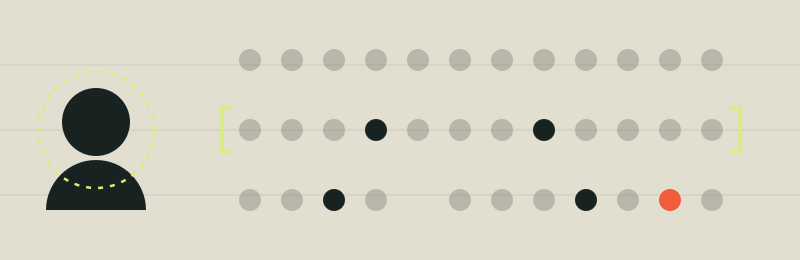
50 applicants a role, ~23 recruiter-hours of screening, $32–$58 fully loaded per 30-minute phone screen.
Meanwhile candidates face cold keyword bots they distrust: only 26% believe AI evaluates them fairly.
Runs first-round exploratory screens in the manager's rhythm and evaluation style.
Discloses naturally, asks the manager's actual questions, and never rejects, ranks with finality, or extends an offer — which is also what keeps it outside automated-decision territory.
Behavioural, quote-rich screen digests with red flags and a worth-your-time shortlist.
Live hours are reserved for finals. AI-screen plus human-final loops cut time-to-hire ~40% with +25% first-year retention.
Pack: Hiring · question bank, evaluation rubric, candidate consent capture, jurisdiction notices, ATS-ready digest template.
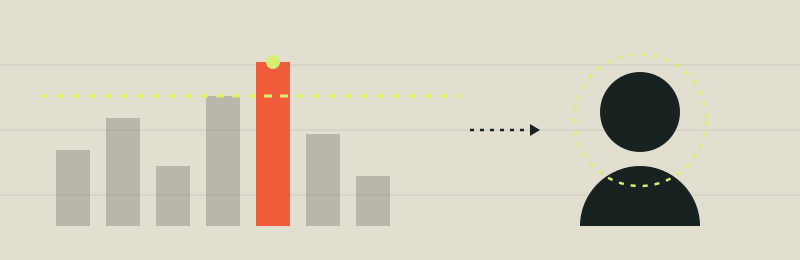
Dozens of inbound inquiries a week; unqualified discovery calls burn the evenings.
11.5M US independents sell services to businesses and 5.6M cleared $100K last year. Their hour is the product, and discovery is the unpaid tax on it.
Takes the first discovery call: scopes budget, timeline, and fit in the owner's vocabulary and standards.
Declines to quote, references pre-authorised ranges only as “typically”, and books a human call only when the project is viable.
A vetted pipeline: scope and budget digest per lead, disqualifiers surfaced early.
Nobody gets ghosted. Every inquirer had a real conversation, which is more than a triage form has ever given them.
Pack: Freelance discovery · scoping ladder, budget-range policy, disqualifier list, proposal-ready digest template.
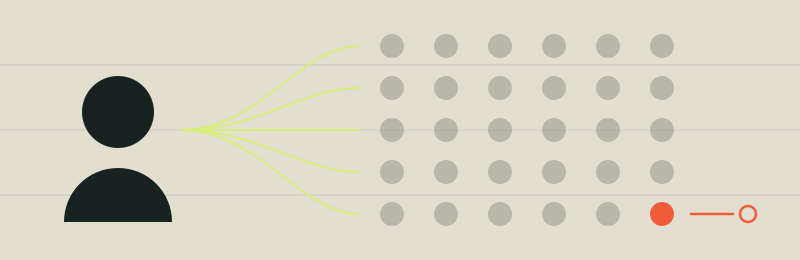
30 start-of-term parent syncs × 30 minutes = 15 unpaid hours repeating the same introduction.
And the parents of the most complex kids get the least airtime, because the clock is identical for everyone.
Holds the intro syncs in the teacher's warm register.
Asks the standard intake questions, listens without a clock, and flags the cases that need a human with authority and empathy.
A scannable per-child needs sheet before week two.
Live time goes only to the conversations that actually needed the teacher. Educator pricing is built for school-year budgets, and the first fifty Founding Educators get Pro free for life.
Pack: Educator · intake questions, district consent text, needs-sheet digest template, 50 Founding Educators on free lifetime Pro.
Today, reaching a busy person often means silence or a filter. MIRA's product hypothesis is that an unhurried disclosed conversation can offer a genuine hearing and return an accurate, high-density reflection to the owner; counterpart research and live delivery evidence are still required.
Design rule
The counterpart must leave feeling more heard than a rushed human would have made them feel — or we have failed, regardless of hours saved.
Post-meeting one-tap rating from the person who met the proxy, published quarterly. Within 90% of a matched owner-run baseline, or the number isn't good enough.
If a proxied meeting scores 2/5 or below from the counterpart, the minutes are free. We invoice on the other side's happiness because we're the only ones who dare.
The pre-meeting notice carries a “prefer the human” option that auto-offers the owner's real slots. Refusal becomes scheduling, not resentment.
Read The Counterpart Test — the benchmark we publish against ourselves →
Where it fits
Everyone circles this space. Nobody occupies transparent, personalised, and boundary-locked at once — because each competitor class optimised for a different promise to the owner, and none of them for the counterpart.
| Capability | MIRA | Notetakers | Clone platforms | Live puppets | AI screeners | Platform copilots |
|---|---|---|---|---|---|---|
| Attends instead of you | ● | · | async only | · you still attend | ● | · |
| Trained on one specific person | ● | · | your content, not your judgment | · | · company-owned | · one twin for a billion users |
| Discloses, non-configurably | ● | ambient by design | varies | deception-adjacent | disclosed, cold | varies |
| Hard decision boundary | ● | n/a | · | · | scores and ranks | · |
| Counterpart is measured | ● | · | · | · | · | · |
| Article 50 pack, day one | ● | retrofit | retrofit | structural problem | partial | enterprise roadmap |
Otter, Fireflies, Granola, Delphi, HeyGen, Pickle, Cluely, HireVue, Mercor, Zoom AI Companion, and Copilot are each excellent at the job they chose. Notetakers capture the meeting you still had to attend. Clone platforms proved people will talk to a stand-in. Puppets proved the demand intensity — 400K downloads for a mask. Screeners validated the wedge. The giants own distribution, so we live inside their meetings rather than fight their platforms. The gap none of them fills is a proxy that is warm, personal, honest, and structurally unable to commit you.
From the MIRA team
Notes from designing an AI that can represent your perspective without pretending to be you—or taking decisions that still belong to you.
Useful delegation is not unlimited agency. Here is how MIRA separates exploration from decisions.
Read the article →Why telling the room—and proving that it happened—cannot be a prompt, preference or premium setting.
Read the article →A framework for measuring whether an AI-mediated conversation remained clear, fair and useful.
Read the article →Pricing
Seat plus metered proxy-minutes, so our revenue only grows when delivered presence does. At an ICP hourly value of $100–$300, five hours back a week makes $99 a month a rounding error.
60 min/mo · hard cap · 1 concurrent
300 min/mo · $0.35 overage · 2 concurrent
400 min/seat pooled · 3+ seats
10,000 min pooled · custom concurrency
Concurrency, per-meeting caps, and the fair-use policy are on the pricing page. Disclosure and consent gates are never rate limits — they are hard gates at every tier, including free.
Problem–solution fit
A short structured survey for people who've had the conversation with us: where a proxy would earn its place in your week, where it wouldn't, and what would have to be true before you'd put one in a real meeting. It asks for your contact details so we can follow up properly.
Private beta · August 2026
Both founders run theirs publicly from week one. Design partners get concierge onboarding, the cold-start interview, and a fidelity review every week for a month.
We onboard in cohorts of ten, so every owner gets a real cold-start interview rather than a login. The survey is how we choose them — it asks which meetings you'd hand over, and what would have to be true first.